Wednesday, November 13, 2013
Friday, September 27, 2013
Skye Trip
A good friend of mine Sandy Ogilvie phoned me six weeks or so ago and casually mentioned he fancied taking his boat out for a last hurrah before putting it into winter storage and how did I fancy St Kilda! I almost asphyxiated with excitement before immediately saying yes without even thinking about logistics. Time wise my editing job has a small amount of flexibility but wife's doesn't, nor do family duties so that left a four day window. Of course four days can easily stretch to almost five if you forego sleep and travel through the night. So the evenings of the last month or so have involved lots of research, team gathering, permission-getting and weather dances. Eventually all were in place for last weekend except the weather, with rain and high winds forecast. The logical thing was to cancel, but despite losing one team member the ever trusty Jon Winter joined me as we left Sheffield at 8pm last Wednesday evening determined to have some sort of adventure.
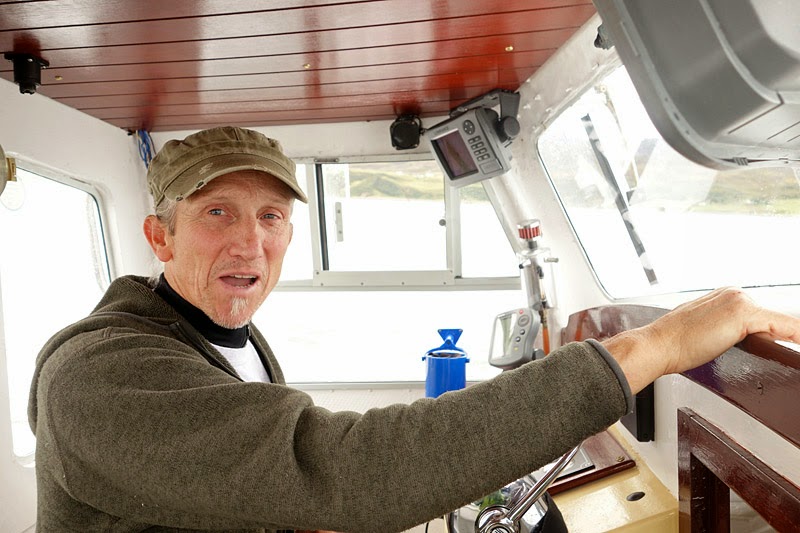
And adventure we did have. No St Kilda but we still got out on Sandy's very splendid boat.
Visiting four islands just off Trotternish in the North of Skye - Staffin Island, Flodigarry, Trodday and Fladda (Fladda Chuain). Here is a seal on Staffin Island which is the only one with no real cliffs.
As far as we know none of these islands have been climbed on. Eventually we opted to try a route on Fladda as it was the furthest one out and therefore the most difficult to reach. Fladda is actually a series of interconnected islands with some strong currents swirling about. Sandy took us into a novel through cave inside one island from where we could scramble round to the main island we wanted to climb on.
And adventure we did have. No St Kilda but we still got out on Sandy's very splendid boat.
Visiting four islands just off Trotternish in the North of Skye - Staffin Island, Flodigarry, Trodday and Fladda (Fladda Chuain). Here is a seal on Staffin Island which is the only one with no real cliffs.
As far as we know none of these islands have been climbed on. Eventually we opted to try a route on Fladda as it was the furthest one out and therefore the most difficult to reach. Fladda is actually a series of interconnected islands with some strong currents swirling about. Sandy took us into a novel through cave inside one island from where we could scramble round to the main island we wanted to climb on.
This was known as Macdonald's Table and had what initially looked like a very attractive 25m face. There were some strong tempting lines, but being cautious we opted for the easiest looking route, which was just as well as the rock unfortunately was catastrophically unsound. Luckily the gear was on whole very good but I must have trundled over 50 different blocks. Jon felt it was the worst rock he'd ever climbed on.
We called the line 'Crumbs from the Table' (route description at end of this post). I think the best approach on Fladda would be to take some ab stakes and spend half an hour trundling for a more enjoyable climbing experience. Still we were definitely getting our adventure fix and importantly the weather was proving better than the forecasts.
The next day we got to visit a cliff that sounded awesome in the guidebook - Rubha Hunish. Home to a four star E2, a four star E3 and the most northerly E8 on Skye. The cliff proved as good as the hype, although once again the rock on the lower half was far from perfect.
The yellow line is the 3 pitch new route Jon and I added. 'Hasbeenfeast' had a particularly superb middle pitch which I'd only semi-seriously considered as from the ground it looked like it could easily be exposed 6b but turned out to 5b.
Here's Jon hanging out halfway through this great central pitch 300ft above the sea. This cliff has a lot going for it including at it's summit one of the best bothies I've ever seen.
Day three and the rain was just about still keeping at bay so we went and checked out the Kilt Rock area. One of the better known spots on Skye with two routes in Extreme Rock, although still plenty to do. In the pic below there is only one route left of the pinnacle for about 200m.
We repeated a Dougie Dinwoodie HVS called Toll Dubh which we, obviously reading too much into the guide description, thought might be an esoteric classic. Esoteric it certainly was! But the rock meant it felt closer to XS 5b/c. Still we got to spot a sea eagle as well as a wealth of amazing unclimbed 40-50m cracks. Our last day finally brought the forecast rain and so we retreated to a dry tooling crag (lines from M3-M9+) that Martin Moran had developed recently back on the mainland at Loch Carron. This was great fun and is well worth knowing about (its in the SMC Scottish sports climb guide) if your are taking a punt with conditions in the Northwest this winter. I even surprised myself by getting up an M8 after a quick bit of figuring out the moves.
We eventually got back to Sheffield at 2.30am on Monday morning, after one of the more fun and varied trips I've ever had. Thanks go to Sandy, who runs boat trips during the main season http://www.staffinbaycruisingandfishing.com/ highly recommended.
New route Descriptions
Fladda Chuain - MacDonald's table South Face
Crumbs from the Table E3 5b (25m)
Climbs the obvious cracked grooves on the leftside of the face. Varied and intersting moves with plenty of protection but unfortunately marred by dangerously loose rock. A thorough clean on an ab rope could potentially give a pretty good route.
First ascent: Ian Parnell & Jonathan Winter 19th Sept 2013
Rubha Hunish - Meall Tuath
Hasbeenfeast E2 5b (80m) **
Takes the obvious weakness starting between Opening Gambit and Willey's Last Stramash before climbing a dramatically exposed diagonal line rightwards across the headwall. The rock on the first pitch is loose in places but much better on the last two pitches.
1. (5a 40m) Start from the top of a rock and grass scramble 20m left of the cave of Willey's Last Stramash. Climb the obvious line of grooves and cracks trending slightly leftwards over a series of ledges until steep and awkward moves gain a stance level with a band of double overhangs to the right.
2. (5b 25m) Climb up slightly left into a niche topped by a roof crack. pull out rightwards from the right side of this niche to gain a horizontal break and then flake cracks which lead diagonally rightwards across the headwall to a bridging rest beneath a roof. Rock up back left to a large comfy ledge.
3. (5a 15m) The overhanging offwidth corner proves an awkward finish.
First ascent: Ian Parnell & Jonathan Winter 20th Sept 2013
Sunday, June 30, 2013
Garden design by man and nature
My day off each week is usually my climbing day, but last week I was feeling pretty bushed so I went garden visiting and bird watching. I guess this means I've officially lost it and am now slipping inexorably into my dottage. The bird watching did enable us to check out Bempton Head which has one route by a certain Mr Cave and Mr Fowler, and by the looks of the cliff it may never receive another. The garden was Scampston Hall, which is the work of one of the most influential garden designers around - Piet Oudolf. His style of drifts of grass and long lasting perennials has been influenced a lot by wild meadows and praries, so it was interesting to see all the fields of wild flowers on the way to and at Bempton Head.
Tuesday, June 18, 2013
A Grand Day Out
Family holidays have curtailed most rock action recently. However I did manage a nice visit to Whitestones Cliffe. I even made a prospective return on my own yesterday and after enjoying the orchids next to the car park headed to the RHS garden at Harlow Carr just outside Harrogate. The massed Alliums are amazing at the moment and there were several other astonishing plants - the Himalayan Poppies which are being trialed at the moment are other wordly.
![]() |
![]() |
Saturday, April 20, 2013
Opening Gambit
I've wanted to do this route ever since Paul William's slate guide came out (1987!!) about the time I really started getting into climbing. It sounded amazing - one of the first routes on slate, one of the longest routes on slate, a moderately graded line out of the incredible big hole Twll Mawr and a Joe Brown route to boot. I was surprised therefore when I finally got my act together to climb it I couldn't find anyone to join me. As I worked down my phone book the list of excuses got longer. Eventually I remembered that I'd bumped into Rob Greenwood at the climbing wall, who'd just moved up to Sheffield from Llanberis, no doubt in pursuit of sport climbing fitness away from a dark past of adventure. Rob initially also refused, fobbing me off with the excuse of work. But I knew he'd just started work for the BMC, and as a past employee I knew the reality. 10 minutes later the plan was on.
If anyone isn't put off by the guidebook description '...be prepared for substantial looseness on all pitches varying from mild exfoliation to tottering of Jenga proportions' It's worth taking a very small cam (black alien) for the crux - crimpy 5a/b whilst being stabbed by a gorse bush. We took lots of pegs but didn't use them.
![]() |
| Rob entering the mouth of the skull during the approach |
![]() |
| Rob 'no headtorch' Greenwood chuffed there is light at the end of the tunnel |
![]() |
| The incredible smooth wall of the meltdown and the Quarryman and the ledges of choss of Opening Gambit |
![]() |
| Rob 'almost-rock-climbing' |
![]() |
| Rob 'turbo-gliding' to the sod of glory? or is he rocking over on hyphen to a gorse thumb-sprag? |
Monday, March 4, 2013
Belts, Marks and Thin White Lines
|
Just in case anyone is
trying to get confused, the following comments are my own and not those of my
day job at Climb Magazine. Also whilst I will be talking about one climber I
don’t wish this to be misconstrued as personal attack on him, in fact I’m a big
admirer of his.
I don’t usually post too much contentious stuff here, to be
honest I’d rather share photos and adventures, but I feel a need to put into
print a few thoughts on some recent ascents in Scotland. During the last few
weeks of February Dave MacLeod climbed several new routes on Ben Nevis, some
such as a new VII near Clefthanger were exemplars of perfect practice – hoared
up rock, ice and deep snow on ledges. Two of Dave’s new lines however were some
way from best practice. The first White Noise took the radically overhanging
wall right of the CIC Cascade ice climbs. Climbed after abseil inspection and
with photos showing completely bare rock this route is so far outside
traditional Scottish ethics that I don’t think Dave would attempt to claim it
as such. Noticeably he has used an M grade (used for continental mixed climbing
– traditionally on bare rock to an icicle, but also used at many ‘dry-tooling’
venues where routes can be climbed all year round) although he does confusingly
compare it grade wise with his own route The Cathedral, a grade X on the
Cobbler. The second ascent that troubled me was of a very well known last great
ice line on the Brenva face called the Snotter. On his second day of attempts
Dave reached the hanging icicles that mark the route creating a VIII,8. Once
again the photos tell a story with the crucial wall accessing the icicles again
completely bare.
![]() |
| Dave Macleod on the first ascent of White Noise M10/11 Ben Nevis Copyright Jamie Hageman |
The ‘magic’ at the heart of Scottish winter climbing arises
not just from this countries great landscape, it’s challenging weather or it’s
world class routes but largely from a universally adopted ethical approach. The
key point being that routes should only be climbed in ‘true winter conditions.’
It is however an ethical code that is potentially fragile. In fact it gets broken
numerous times every season usually in the desperate rush for a first route of
the season, on minor routes with the consequence usually only ripples in the
conscience of those individual climbers. This time however the climber involved
is the most influential climber in the UK and the flag bearer for Scottish
climbing on the international stage. Also at least one of the routes was a much
coveted last great problem on Scotland’s signature mountain.
Both routes were publicised together, but it is perhaps best
to deal with them separately as they raise different issues. White Noise is
perhaps the starkest transgression – from what Dave has written on his blog it
seems obvious he was aware that this would be a controversial route ‘I wondered if a big ‘dry’ roof
climb would be accepted. Things have moved on a bit in recent years though,
with most folk realising that the biggest roofs in certain places in the
Scottish mountains just do not get rimed up and so must be climbed in the
prevailing conditions, or left. After years of passing those cracks it suddenly
seemed totally stupid to leave such good routes unclimbed, so I went back up
and did the right hand crack.’
I for one certainly don’t think
White Noise is acceptable – it’s basically not a winter route but a pure
dry tool route that can be climbed at any time of the year. Dry tool routes
have a tenuous place in British climbing but surely not on our greatest
mountain. If White Noise had been climbed in a quarry it would have been
applauded, if it had been climbed in a quiet Glen on a low profile natural crag
then it would have been silently ignored but right in front of every climber
passing by the CIC hut is as provocative and inappropriate as any indiscretion
I can think of in Scottish winter’s very colourful history. I sincerely hope
the route will be left as an aberration and not emulated by any other winter
climbers in Scotland. If it’s accepted then dry tooling is fair game on any
mountain in Scotland. Also I don’t buy some of Dave’s justifications about
steep rock not hoaring up. It depends largely on where the route is; on the
Cobbler where Dave’s Cathedral route is everything hoars up take a look at the
pic below of Greg Boswell’s recent repeat. In the Cairngorms and on the Ben
most bits of rock hoar up, how frequently depends on the altitude. In the case
of the low lying White Noise it is likely to be extremely rarely, but the higher
Anubis (another of Dave’s super hard super steep routes) hoars up pretty often
(Dave himself attempted it in fully hoared conditions). In the North West
hoared conditions are rarer and different winter indicators are needed such as
frozen turf or ice. With patience almost every higher altitude objective will
at some point come into extremely wintery conditions. I can’t think of a better
summary than the comments of one leading activist who called the line “White
Nonsense”.
![]() |
| Greg Boswell repeating the Cathedral Copyright Adam Russell |
The Snotter is more subtle, and judging by the internet
responses I’ve seen perhaps splitting opinion. Some feel that because the
hanging icicles were such a focus of the route that it justifies accessing via
bare rock. My own view is that it’s an unfair Scottish winter ascent. Obviously
with that much ice the route isn’t a summer climb and I’m fully aware that many
ascents of winter lines have been made in marginal conditions, where the odd
section has moves on bare rock. However with The Snotter the whole of the
crucial section of the route is seemingly devoid of winter’s touch. That
section of the route does get wintery and will have been so already this
season. Dave lives pretty much at the base of the Ben, and I know he’s been
injured and I’m sure was keen to get in on the action, but this major last
great problem deserved to be climbed in the best possible style.
In Scotland our ethical process is at times puzzling,
nebulous and definitely frustrating. But I feel by letting our routes keep
their winter defences, they are transformed into great climbing experiences.
The value of such an approach has been proved to me time and again when I’ve
introduced climbers visiting from overseas to Scotland in the winter. When you
describe the fact that we must wait until the rock looks white, only to then
scrape away the snow in order to climb a route brings forth looks of utter incredulity
“are you guys nuts?” But when you listen to those same climbers, after they’ve
done a route they enthuse about Scottish winter climbing.
This is perhaps why I am being harsher on Dave than I might
be on others, Dave is in the position where almost any ascent he does gets reported
on the international media – his blog post about these two routes was picked up
immediately by UKClimbing.com and Planetmountain.com, and news will now have
spread worldwide. Dave’s is nigh on worshipped by many grass roots climbers –
what he does and says is often read as gospel. His influence on an
international level is also highly significant – his routes such as the Hurting
were a large part of the reason stars such as Charly Fritzer, Dani Arnold and
Ines Papert have visited Scotland. The rich experience many overseas climbers
have had in Scotland’s winter has I believe been a significant part of the trad
revolution currently sweeping through mixed climbing. It would be a real shame
if that message became confused by ascents like Dave’s recent ones on the Ben.
The title of this post comes from a post Simon Richardson wrote on his Scottishwinter.com site called Overstepping the Mark and a response Dave wrote today on his blog in which he felt simon was 'particularly below the belt'. Interestingly as of this morning Dave has amended his original blog post reporting both ascents and removed the photos of The Snotter, Planetmountain and UKC for some reason have also removed images of the route and UKC have changed the title of their news post [EDIT I got confused here and UKC didn't use Dave's Snotter pics at anytime].
Thursday, February 28, 2013
Northern Norway Part 2
My recent trip with three friends to Northern Norway was one of the best I've ever had. We've only been back 48 hours and are already planning next years visit. I'll probably write an article for Climb in the Autumn so I won't witter too much here. Instead here's a few pics of the climbing (see Part 1 post for some scenics).
We only managed one route in the Southern part of our trip - but what a route Flagbekkan WI5-6.
Zooming out gives the true scale.
There is a huge amount of ice, most of my pics are of steepish stuff but there is plenty at every grade. This was a fine 180m IV+ - V
A closer shot of Kenton on the V, called by some Cathedral, others Goldrush but with no doubt other names.
This crag was called tongue in cheek called Roadside but was worth the hike. The red line was a great WI6, M6 the yellow a WI6+-7 and the Green a WI6
Here's Neil on the WI6, M6
There were a really obvious pair of ice lines up high which we had no info about. I ended up climbing the right hand column in this photo as a 55m WI6 pitch the central of 3 pitches. It's the best ice pitch I've climbed.
Neil and Garth climbed this beast to our right at a surprisingly amenable WI5+, M5
Here's Garth topping out on that line.
As well as fjordside climbing there were an interesting series of gorges. This 3 pitcher had been climbed by Kurt Astner but the central pillar had collapsed leaving a big roof. Garth sussed it out and then I shook myself across and Kenton cruised it.
This was our final route in the Lyngen Alps, and one of the routes that had attracted me to go - Gullyvers Reisen WI5 - a total classic.We only managed one route in the Southern part of our trip - but what a route Flagbekkan WI5-6.
Zooming out gives the true scale.
Subscribe to:
Posts (Atom)